I left Substack - here's why
Non-existent ethics, a clear move toward social media, and a positioning business decision. Here's how I made the decision to leave Substack, where I am now, and what you can take from this if you’re questioning Substack as the right platform for your creative and professional publishing.


In October 2025, I was putting together my first ever offer, (re)launch your digital library, and shared my shiny new sales page with my partner. At the time, I was also part of a mini Substack challenge in my favorite online community, the Lab, where we nudged each other to publish our writing and learn about running a Substack publication.
To say I was obsessed with Substack is an understatement.
I had been using it for my personal writing for a year already, and I was spending hours scrolling through my feed in search of creative voices like I was a magazine editor again. I paid attention to how people were writing and what opinions they were putting out there. I had fun explaining what the lighthouse library was about and I published my first big opinion essay, where I was officially breaking up with content marketing.
So it made sense to me when, after reading my new service page, my well-meaning partner asked me: “Why does your sales page say a digital library? You’re on Substack, so it should say you help launch Substack publications instead.”
At the time, I didn’t have the words to explain with confidence why choosing the simpler, more straightforward, and definitely easier to understand Substack over a digital library would not work. It was already clear to me that Substack would not be the most fitting platform for everyone – just like LinkedIn or Instagram is not systematically the best visibility platform for everyone. Working with my first handful of clients over the past six months has confirmed that.
In my moments of doubts, I thought: yes, there’s a business opportunity for me there. People are starting to understand what a Substack is, like an Instagram, so I should capitalize on this. (See where I am going with this? I am not a person to “capitalize” on things. That is not why I do things; that is not why I run a business).
A few weeks later, asking for feedback from my business strategist friend on my ready-to-go offer page, I shared my doubts. Do you think I should say Substack instead of ‘digital library’? After a pause, her answer was another question: What do you think you should use?
I was practical in my answer. My inkling that Substack would not be the right fit for everyone was confirmed early on: I’d been in conversation with a friend and future client who, when she asked whether she should move to Substack, I advised against doing so. I didn’t have anything against Substack then, at least not consciously. It simply didn’t make sense for her and her business at that moment.
So that’s what I told my friend. I also added that I’d hate for someone to think I can’t help them publish their writing online simply because they don’t want to publish on Substack.
Fast forward to a year, a handful of clients and conversations later, a whole lot of writing and publishing experimentation under my belt, I am making the move that makes sense for me, my business, and my budding digital library.
Between deceptive marketing, non-existent ethics, a rapid move toward becoming yet another social media platform, the toxic growth talk… I've left Substack, and this is how I made my decision.
Proceed with care – do not let this become your next shiny object
Before you go any further, I need you to hear me out: This is a major business decision I spent many hours thinking about, pondering, doing maths around. While Substack’s marketing likes to make you believe you just have to write and publish, the reality is that running a “successful” publication takes more than conviction and good ideas.
It is time, creative energy, a direction, and space in your head and calendar that make it work. The same applies to this decision.
Ultimately, it was the collection of viewpoints and other avenues I explored that led me here. I will share mine here – take what you need and leave the rest.
My problems with Substack
It was really hard to decide which point to tackle first because I’ll be honest, at this point, after a couple of months without logging once into the Substack, all I see is noise. The reason I came to Substack was to publish and read newsletters, and it looks like they’ve lost the plot.
Substack’s deceptive hyper growth marketing: it’s easy to make $$$$$ writing
When I first considered Substack as an option to publish my professional writing in August 2025, their website read: “Building a new economic engine for culture.” I was impressed by the creative branding, the big-name publications advertised on the home page, and – browsing through those publications – by the nuanced and deep thinking, too. It reminded me of the old internet, stumbling upon insightful blogs randomly, where algorithms didn’t dictate what was worth reading.
Now in October 2026, it says: “Make money doing the work you believe in.” It has become about money and followers rather than sharing interesting ideas. “Make money right away, grow faster, become part of an impressive 5 million paid subscriptions!”
If you dive a bit deeper, 5 million paid subscriptions means unique subscriptions, not paying humans. It means 5 million publications have turned on the toggle to “go paid” in their settings, but that’s only 5.7% of the platform’s total publications.
Their biggest selling point is that you can just start today, and that part is true. Create an account, no fees, and you can just start writing. But running a paid newsletter or publication takes much more than signing up on a website – and this kind of messaging sets any user up for failure. The writers who make money off Substack have put tremendous work into it; spending years honing their craft, their expertise, and thinking strategically about how to bring value to a readership they care about.
(Either that, or they moved to Substack when they already had 300K+ followers on Instagram, which again illustrates that “just start” is not a foolproof strategy.)
When I signed up, I thought Substack would be different: It was about giving writers and creative businesses the tools to make a living by writing. But in the end, the growth talk is toxic, all-consuming, and counter-productive. I just didn't want to be there anymore.
Substack’s non-existent ethics — publishing alongside neonazis, transphobes, and to the benefit of investors who don’t care about the craft of writing
This is the point that has made me increasingly more uncomfortable as time passes. Over the past few months, when I’d log into Substack, I’d think of Archbishop and activist Desmond Tutu and his famous quote: “If you are neutral in situations of injustice, you have chosen the side of the oppressor.” I kept feeling like an impostor. My thoughts were swimming. I thought to myself, so what, you go to the Gay Pride every June and read Octavia Butler and say you care about defending and uplifting marginalized groups, but you’re still on Substack, where white supremacists and transphobes seem to thrive.
Many writers and journalists have written much more eloquently about this than I could, so I’ll let them speak, for now.
Ann Helen Peteressen, journalist and creator of Culture Study, a newsletter, podcast, and community, wrote in Why Culture Study moved to Patreon: “I don’t want to be deeply invested in a platform whose business model is rooted in snagging readers through algorithmic manipulation. I don’t want to make money for founders who refuse to draw a line about platforming hate speech. I don’t want to serve as a one-person IT department for my readers and listeners who can’t resolve their account problems because Substack’s ‘support’ has been reduced to a bot. I don’t want to constantly fight Substack’s inclination to turn ‘readers’ into ‘followers’ who live on their app.”
Lex Roman, indie publisher of Revenue Rulebreaker, was the first person to show me leaving Substack isn’t only possible, it’s necessary if you intend on building an independent reader-supported publication.
They have written many (many) pieces and LinkedIn posts about Substack, but in this one, they ask: “Are we building independent media or are we building platform-dependent media?” Substack’s initial strength was to give writers and publishers a simple tool to publish their newsletters that would then turn into an archive, independently. Writing was the product, not a marketing tool. Now, Substack is more interested in monopoly, and the way the platform is developing proves just that.
If you needed more convincing, Lex Roman also mentions in that piece that one of Substack’s investors is also a backer of OpenAI and Meta. To me, that sounds like supporting the opposite of nuanced thinking and independence of thought.
(Lex Roman even has a Substack policy for new paid readers of their publication, where they explain that they left tech to stop helping the bad guys, and that as Substack grows, they don’t want to play any part in the building of a monopoly. I admire that.)
Listen to this conversation on Off the Grid: Leaving social media with Amelia Hruby – Making Content, Raising Revenue & Moving Off Substack — with Lex Roman of Revenue Rulebreaker.
Nathan Tankus, transwriter and activist, wrote about Substack platforming trans hate and transphobia. He listed out the dangers of letting transphobia and bigotry become mainstream and normalized in this piece, naming the rollback of trans rights in the US and the UK in recent years as a direct result of this. When you look at what JK Rowling’s Twitter campaign turned into and how it contributed to the anti-trans rights movement in the UK, it becomes all too real.
Mark Delong, writer and columnist at 3 Quarks Daily, wrote about Substack’s “enshittification” process, a word also generously used by Ann Helen Petersen in her piece above. In Mark’s words: “I’ve found [...] distracting the transformation of the Substack platform’s character in relation to writing: Perhaps simplistically and too idealistically, it once aimed to focus on writers and their craft and then turned into … something different—something that engages writers by binding them to apps, social media banter, video, streams, all with engagement statistics.”
The toxic growth talk, the move toward social media; I could have closed my eyes on those. But the case put together by these writers, journalists, and publishers was impossible for me to ignore and ultimately led me to my decision to leave Substack.
Substack’s rapid move toward a social media platform
Before it was cool to be on Substack, it was a simple newsletter platform with payment options.
Substack first introduced Notes in Spring 2023 – a new feature that allowed publication authors to post Twitter-like snippets of thoughts. It has now become the ultimate Substack growth engine, positioned as such by Substack and growth writers on the platform. While it would be another year before I’d explore the platform with my own hands, that was when writers – like Mark Delong – started seeing things getting fishy.
“We’ve always thought the magic of what Substack is doing is the fact that we’re disintermediating the people creating stuff and the people who are consuming it — you are the brand they’re paying for,” Substack CEO Chris Best told TechCrunch in 2019. Now, it seems like things are shifting in a different direction – they are “intermediating” the people creating stuff with social media gimmicks. In recent months, a new button made its entrance on our profiles: Follow. This is where readers stop being subscribers; where we become users more than we are writers. Substack does not care about our writing careers or that we want to write with meaning and soul and insight and genuine growth. They care about their app’s valuation and usage.
The fallacy of Substack’s discoverability & recommendation tool
Substack’s discoverability features have been pitched as a proven growth tool you couldn’t find anywhere else. The recommendations feature is one example: You can recommend publications you enjoy, copying a simple, natural mechanism, which is that when someone you trust recommends something worth checking out, you listen more closely than you would to ads or random algorithmic suggestions. Their algorithm-driven feed is another of those features.
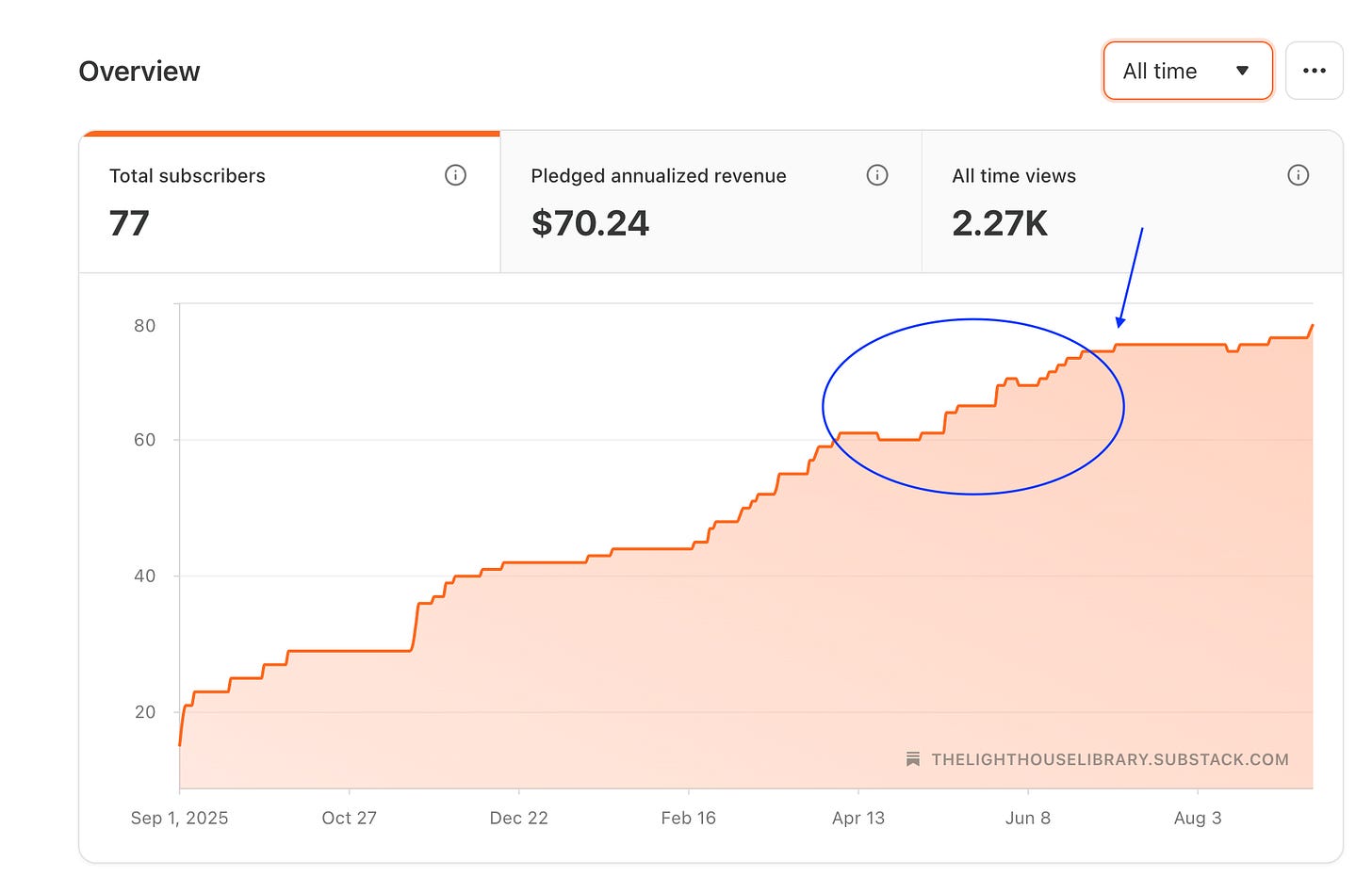
Now let’s have a look at the tiny data I have here, keeping in mind that I “only” have 77 subscribers (a big room full of wonderful humans!).
If you have a look at my graph below, you’ll see the total number of subscribers was steadily increasing from February to June this year.
Now, if you look at the arrow, you’ll see that the number of subscribers stalled in June.
If you now look at the zoomed in graph below that shows “views,” you’ll see that right around the second week of June, the number decreases.
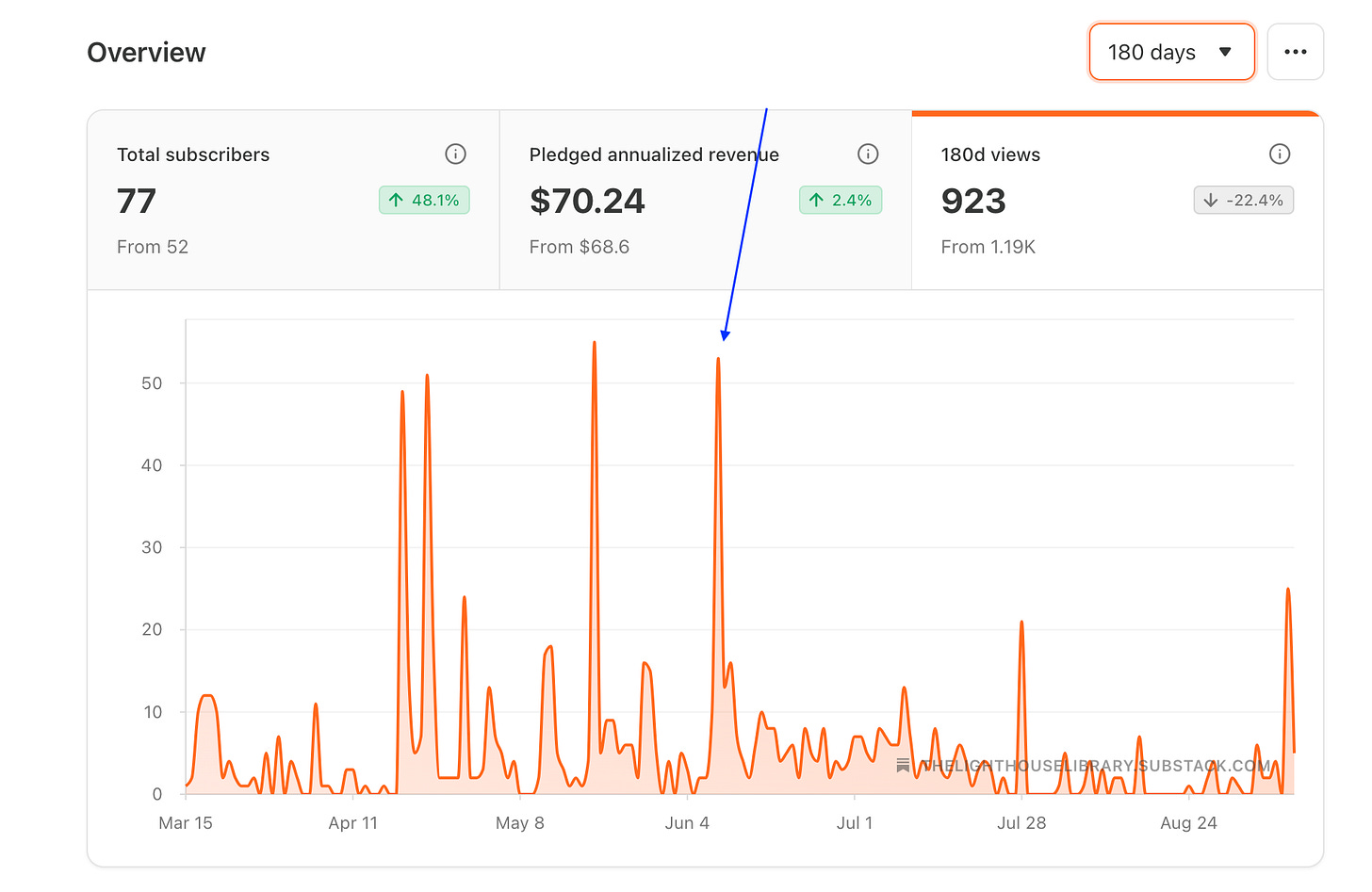
I published my last piece on June 9 and wrote my first new Substack Note on September 9th, which is the last spike in view. I took a long break from writing and publishing across all platforms, and did not write, publish, or talk about my beloved publication from June to September.
Substack did not gift me ✨magical ✨ new subscribers or views.
*I* did.
It is my published writing, and me talking about my published writing, that brings the views and the lovely humans who decide to sign up and continue reading my words. From the moment I started the Lighthouse Library, I was publishing regularly, texting and DMing people about my new pieces. I was sharing my writing in my online communities, posting about it on LinkedIn. I even gave Notes a go (although that got me 0 new subscribers and I had strong thoughts about that short-lived experience).
The recommendation tool optimizes the process of recommending someone’s writing, sure. But we can’t know with certainty whether someone subscribes to your publication because they genuinely enjoyed it, or because they accidentally clicked on “accept” three times when Substack told them “Here are recommendations for you because you followed Jane Doe” with a bright orange button calling a human brain’s attention. Whether those new faces stick around and end up engaging with your writing and work the way it’s intended for is another question altogether.
Substack is not better than any other social media platform at recommending or helping you get discovered. If readers subscribe to your publication, it’s because you publish writing worth reading, and you put in the marketing work to show up. That will be true whether you’re on Substack or any other platform that allows you to take monthly payment, if your goal is to make money off your writing.
Where to next? On ethics and positioning (and a couple of trade offs)
After determining that Substack was no longer for me, I moved to Ghost.org - like Lex Roman and Nathan Tankus, publishers mentioned above. (Turns out Gay Times uses Ghost and lots of amazing organizations like Tiny New Collective too!) It’s a non-profit, i.e. not a platform that’s interested in growing fast or achieving monopoly status. They care about publishers and writers having the tools to own their writing and get paid for it. I paid for this move myself.
Trade offs that don’t really feel like trade-offs:
- Because Substack users have used the platform differently in recent months and are spending more time on the app and less reading actual newsletters, I wonder how that will impact my open rates, for lack of a more human term. Only time and experience will tell. I’ll report back.
- Many friends and writers I have enjoyed interacting with on Substack are…still there. I have to find new ways of interacting with my favorite writers. That has already started and hasn’t been that hard – I’ve been reading their emails more, visiting their actual publications to catch up on their published writing, and continuing conversations in DMs and emails. Quiet moments reading over endless Substack scrolling - that is a trade off that doesn’t really feel like one.
- Ghost is not free. The Starter plan is $180 USD a year for up to 1,000 subscribers, $350 USD if you have more and want to take paid subscriptions. That said, it takes 0% of your earnings (where Substack takes 10%). To break even on Ghost, you need 4 paying subscribers at $10 USD per month. As soon as you have 36 paid subscribers, you’ll keep more money on Ghost than on Substack. Since my website has been living on Notion, I’ll be centralizing everything on this one platform instead of paying for another platform like Squarespace or Webflow, which cost the same for the features I need. So here’s another trade off that doesn’t feel like one.
- I have to unlearn Substack’s marketing narrative about their discoverability perks. I have to remember to still put in the work if I want new eyes and existing readers to keep reading my words. I have to stay creative and find meaningful opportunities to make my writing visible. That’s arguably harder than posting stray thoughts in Notes.
Even with those trade-offs, it was a relief and a proud moment for me to pay the $180 USD and migrate all my published writing to thelighthouselibrary.co.
Reasons I’ll continue to defend my move and next steps
When your core values remain true to who you are, business decisions like this one feel less like playing a game of catch up or being influenced by the “shiny new objects” out there.
When I say I support independent publishing, I want it to be true in my actions, too. I don’t buy books on Amazon but from independent booksellers and small indie publishers; I buy self-published books and help my clients understand that being a NY Times bestseller is not the only reason you should consider writing a book. Publishing my own writing on platforms that believe in real independent publishing is part of that thinking and decision-making.
This move also contributes positively to my positioning. I want to be seen as an independent publisher with strong ideas about and expertise within the digital publishing industry. I do not want to be seen as a business owner with a Substack newsletter. Ghost allows me to be that right now.
Whether you’re on Substack or considering starting a publication there, I hope I’ve given you food for thought and reflection avenues to make your own decision – just like great critical thinkers helped me make mine.
What does this trigger in you? Were you considering starting a Substack publication, and has your thinking changed? Are you a paid writer on Substack, and will you be considering a move somewhere else?
I’d love to hear from you, so let’s talk! I’m most active on LinkedIn, and only an email away at ely[at]ebsnotebook[dot]com.
You can now find all my published and upcoming writing at thelighthouselibrary.co, and if you’re already a subscriber of this newsletter, you’ll keep receiving my essays in your inbox. This Substack publication will stay alive but dormant, and by the time you’ve received this, it will be updated accordingly.
This piece was edited by Jordan Parker.