What's missing from the Substack growth conversation
After a short-lived experiment with Notes and 0 new subscribers, here’s what I’m inviting us to focus on instead of growth at all costs

I said I wouldn’t do it again. That I wouldn’t let myself be talked into playing the algorithm games on Substack, like I did back in 2018 with Instagram and SEO tropes. But here I am: reporting back on an attempt to follow the latest growth tactic.
In my defense, one needs a tremendous amount of willpower to shut out the same old social media discourse we’ve witnessed over and over again. The insidious brainwashing is deafening.
But let me backtrack for a second.
Digging into Substack Notes
In an attempt to deepen my understanding of Substack for work purposes, I decided to spend more “research time” on the app. I’ve enjoyed reading Substack Notes. I like learning more about my favorite writers’ lives (Jane Pike’s work-in-progress art and reflections on Spoon theory), Emily Tisshaw’s comfortable and stylish desk) or organized bite-sized thoughts (Benjamin Antoine on creator guilt, Joel Uili on the importance of craft).
After seeing them post regularly, I thought: Maybe I should give it a try?
It is important to note that in 2025, Substack made their “For you” setting and endless flow of Notes default. Hmm, where have I seen this before? Suddenly, my feed was full of people I didn’t know, and some Notes were most definitely not messages I was looking for. I was getting versions of “Here’s how I grew on Substack” essays and “I posted on Notes for 30 days and got 1,000 new subscribers,” and what can I say…They got to me. Many folks mentioned that Substack Notes were how they got discovered by readers. While it all sounded great, I couldn’t help but picture the Substack machine-learning engineers behind their screens, coding away so any Note or essay mentioning “Substack growth” gets a little visibility boost, like modern-day gods.
Initially, I saw posting for 30 days on Notes as a creative challenge. I went in like a scientist with a hypothesis: Am I able to tighten the core of my ideas so much that they fit a Substack Note? What if the creative exercise of thinking in sentences rather than essays could help me clarify my core thoughts?
And creative, I was. At first, I enjoyed having a space to write poems about growth and social media – ironic. I also enjoyed the challenge of turning a big – albeit budding – idea (how to fix a consistent lack of publishing consistency) into a three-part series where I shared realistic elements that a writer needs to set a sustainable pace for any given life phase. (Here they are: 1, 2, 3)
I also loved scouting out new voices so I could re-share them. If there’s one thing that spending more time on Substack has confirmed for me, it’s that I want to uplift other people’s voices. My favorite discoveries have been Shabnam Nasimi (Our Forgotten History, thinking critically about how the West perceives the East, e.g., Afghanistan is not the graveyard of empires) and Hannah Bay (Quiet Growth Chronicles, mixing creativity, financial stability, and a gentle approach to Substack).
Throughout this experiment, I kept reading those “How I gained 10 million subscribers in 2 days” articles. Some were indeed thoughtful, but most felt exhausting. And many offered advice that lacked real context.
What’s missing from the Substack growth conversation
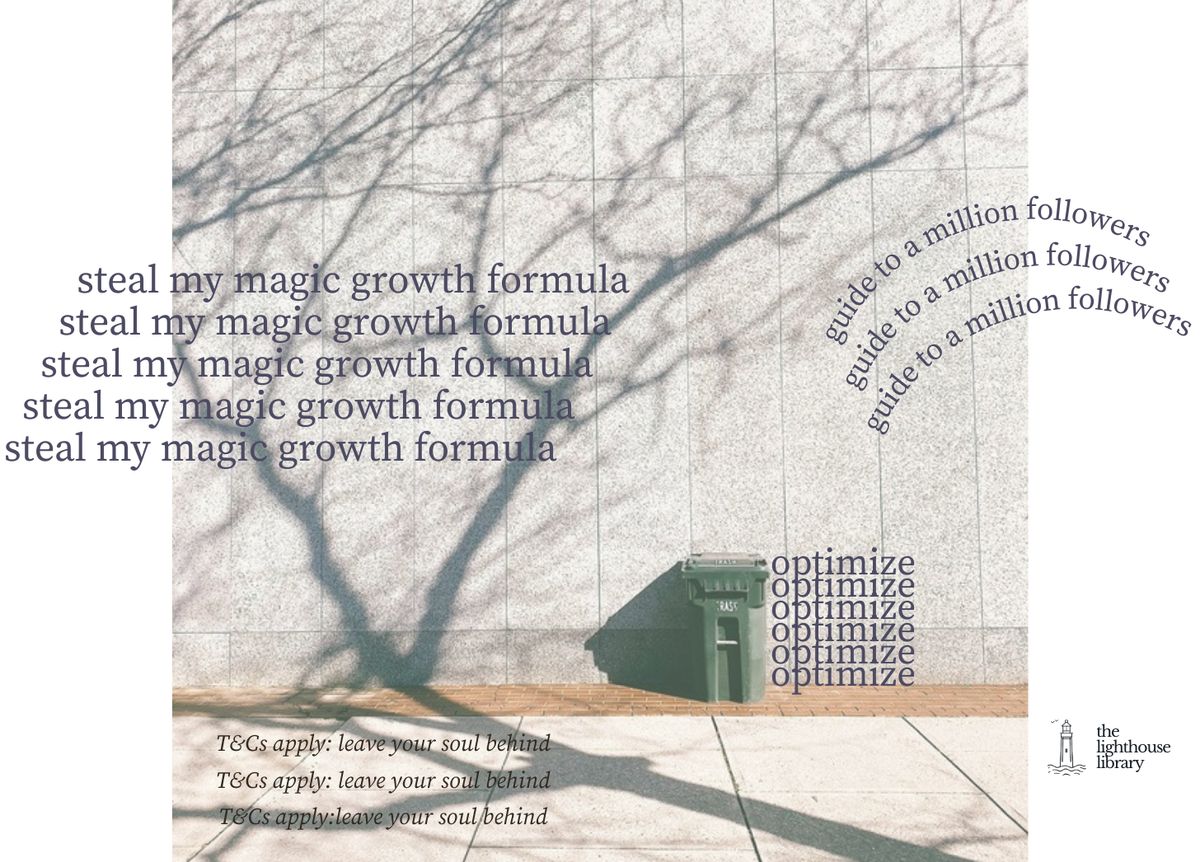
I see the same patterns with Substack Notes that I’ve seen over the years about social media discourse. We used to love these social platforms, until the ads – and the reminders that late-stage capitalism can’t let anything exist just for fun – started flooding in with messages like:
- Optimize this!
- Follow this magic formula!
- Here’s my step-by-step guide to a million followers!
- Own your followers! Monetize them! Forget they are people!
- Nurture your list! Even if you don’t have anything to say!
- Build your sales funnel from socials! Even if you’re not sure what you’re selling or how to deliver it well!
Places full of creativity and originality can quickly become another high-pressure environment where you have to be louder than one another. It forces us to compete when competition should be irrelevant.
Posting Notes every day is not the way to go for everyone.
Being on Substack, Instagram, or LinkedIn is not for everyone.
Building a course to diversify or stabilize your income is not for everyone.
Decisions like these are much more personal and contextual than “growth experts” have us believe. The sense of urgency overpowers to such an extent that we lose all critical thinking ability.
Another thing the experts forget to say is that you need to have such clarity about your posture and voice that you are able to produce Notes in alignment with what you actually think. It’s like applying a minimalist principle to writing: The less there is, the more thought has been put into what is left. That’s why I appreciate voices like Joel Uili so much: They say, it might be 2026, and everyone is going to Substack and throwing spaghetti at the wall, but craft and high-quality thinking still matter.
When playing the game feels like drifting away from yourself
On the 10th day of my experiment, I stumbled upon another Substack growth article titled, “Here’s what I would tell you about growing on Substack if I wasn’t scared of hurting your feelings.” Not a fan of the tone, but I was curious. The author made a great first point: She wanted a book deal, and the agent told her to start growing a following on Substack (this was back when Substack wasn’t the latest iteration of shiny object syndrome). That’s what publishing houses want. You have to play the game, and yes, it is frustrating. I liked that she acknowledged the emotional friction against the dream outcome.
But then one of the listed pieces of advice read: You have to post the odd unhinged Note here and there; that really works.
I’m sorry, what?
I am not unhinged. I am a quiet, selectively private person who thinks and writes about stuff for months before sharing it. I am the opposite of unhinged. I thought back to my teenage self for a second, feelings of inadequacy cropping up. I felt myself frown, and I shook my head. I might have scoffed, too. I am an adult now, and I do not have to be unhinged to please the crowds.
This “be unhinged” advice is beside the point – for me and so many. If anything, the recommended course of action is counterproductive. The clients I work with are deep thinkers, experts in their fields, who are afraid of being judged for getting things wrong or oversimplifying concepts they’ve worked with for years. One reason they feel so inadequate in public digital spaces is that they feel they cannot be themselves. Being “unhinged” is not a good look for a dietician or climate educator who is working hard to build their credibility with a nuanced understanding of their intellectual terrain. Articles like that one, while well-intentioned, kill our confidence to show up at all.
That was when I stopped the experiment.
Mistaking consistency of posting for consistency of thought
Let’s go back to the minimalist idea for a moment. If you want a minimalist wardrobe, it will only work if you: a) know your tastes to a T and b) your wardrobe can somehow accommodate your natural life changes – in mood, body shape, and seasons.
After that 10-day experiment, it hit me: I’m not ready for a minimalist wardrobe. To add onto the analogy, I feel like I am at the beginning of a pregnancy. My old clothes don’t fit anymore, pregnancy clothes are still way too big, and the shifts are happening quietly, long before the outside world will ever notice.
Rather than post to Substack Notes every day, you know what I need instead?
Time and space.
On the one hand, time is essential to let my ideas grow, just like a baby takes nine months to grow fingers and toes, lungs, and eyelashes. There is no way to make this go faster, and no reason to. A baby’s DNA is there from the moment of fertilization. My ideas’ DNA is there in my head.
On the other hand, I need space to let my ideas be, dance, move, rest, and be influenced by their environment. Did you know that research shows the food we eat during pregnancy is likely to impact the future tastes of an unborn baby? I like to see conversations as new tastes I give my ideas. The more I think in different contexts, with different people, in different ways, the more they grow into what they are meant to be.
Take this very piece, for example. Since I was doing the experiment and consumed by the growth talk, I first thought I’d share my frustrations in a few Notes. Then I realized, wait, this is unlike me. These thoughts are for my journal and conversations with friends.
Then I started writing an essay about it, but I was simply too angry and frustrated to say anything remotely interesting or useful. Of course, interesting and useful is relative, which is exactly my point. What is interesting and useful for my digital library, my body of work, and the way I want to interact with my public ecosystem is up to me. Writing an angry note about my thoughts on the Substack growth discourse is not part of my publication’s editorial line.
With some time and space, I finally started writing this essay. Ten paragraphs in, I paused, backtracked, then started weaving in a client conversation about communication, and expanded on an earlier piece from a different angle.
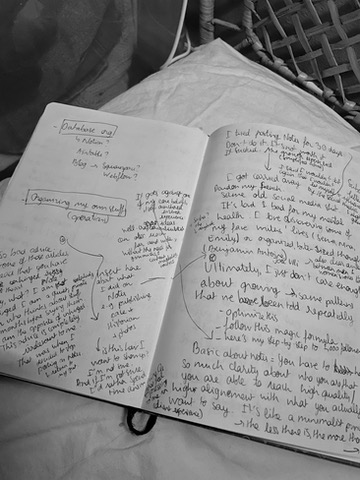
This piece reflects my broader perspective on the digital space we exist in, and how I want to show up in it. It also reflects what I do for work, because I had time to connect the dots between what I say in client calls, and what I write here.
That is how I am building consistency of thought – and that is often left to the wayside for the sake of posting consistency. Intellectual integrity, craftsmanship, nuance, context…it is much more difficult to focus on those when performance pressure occupies all the space in your brain.
Having said that, time and space and posting Substack Notes can go hand in hand. If it fits you and your editorial line, then adelante – long live Substack Notes! But for many, building consistency of thought requires the focus to be somewhere else.
Think less about Substack, more about building a body of work as an ecosystem
Substack is a fantastic platform to build a body of work. Your essays go to people’s inboxes and get compiled effortlessly into an archive that you can then organize as you please. It makes publishing long-form content accessible and doable.
For writers, it’s a spark of hope: You can make a living from writing. It is hard work, but it is now possible. That is amazing and worth embracing.
But if your goal is not to grow on Substack, but to grow a body of work that is clearly linked to the rest of your professional ecosystem that you can reference time and time again, if it is not your goal to tighten and clarify your thinking, then I think posting Notes every day might be a waste of your precious time.
If you needed a permission slip to be inconsistent with Notes, or with your publishing pace for that matter, here it is. Choose to be consistent with yourself, your work, and the ideation phase you are in. Ask yourself:
Would I be proud of sending this post or this essay to a client who knows me?
Does it reflect who I am as a professional, business owner, and writer?
Does it contribute to the goals I have for myself?
If the answer is not a confident yes, then allow yourself to ask what would turn it into one.
While the contributing factors to inconsistency are many, publishing things that don’t sound like or feel like you is definitely one.
I’d love to hear about your experience with Substack Notes. Leave a comment to tell me about it!
Wishing you gentle sailing, thinking, and publishing,
Ely
This essay was edited by Jordan Reed.
Welcome to the Lighthouse Library 💡📚 I help people bridge the gap between how they work and how they communicate about how they work. If your work feels inspiring, intellectually stimulating, and purposeful, but your communication feels pointless, rough around the edges, or scattered, let’s talk. DM or reply to this email!