4 reasons to become a better self-editor
Your writing isn't "bad" and deserves to reach "published" status. All you need better editing - here's why.
A few months ago, I was curious to see what my fellow editors were writing when it came to editing. I am convinced that good enough writing doesn’t need to be labeled “bad.” Instead, it might just need a few rounds of kind and high-level editing (to make sure it aligns with the writing ecosystem and gets a point across). Yet, few writers know this. Unless you’ve worked within publishing, as an author or magazine contributor, the focus in the online discourse when it comes to becoming a better writer mostly focuses on the writing itself.
I stumbled upon a piece on Substack by Mallary Tenore Tarpley, a journalist, author, and professor at the University of Texas at Austin, who wrote 10 tips to become a better editor.
Two stood out for me. First, “Do a sit-on-your-hands read first,” a recommendation to read the whole piece first, then edit to make better informed decisions. It is not as easy as it sounds! Second, “do front-end editing whenever possible.” That one argues for the editing collaboration with the writer to begin before they start to write. In my experience, it can end up saving a lot of time. Sometimes we think we know what we want to say, only to realize 2,000 words later that we have lost the initial thought and purpose of the piece.
Reading Mallary’s piece was like I was in Harry Potter’s Ollivander’s wand shop and found my own wand, overcome by this feeling of lightheartedness and sparks all around my head. She was putting words onto my lived experience: (Self-)editing is not about finding what’s wrong with your writing. To me, it’s a bit like becoming a translator of your own mind, asking yourself what you really want to say, how you want to say it, to whom, and why it matters that you do.
I realize that I love editing because, in essence, it:
1) helps a writer get the point of their message across – loud and clear, and
2) makes reading and ideas more accessible to more people.
It brings incredibly complex and important ideas within a reader’s reach by improving readability and accuracy. It’s about assuming the best of the reader and defining how we want to enter into conversation with them. It’s about finding the most relevant and coherent ways to influence the reader, whether we aim to entertain, educate, teach, offer opportunities for self-reflection, foster belonging and community, and so much more.
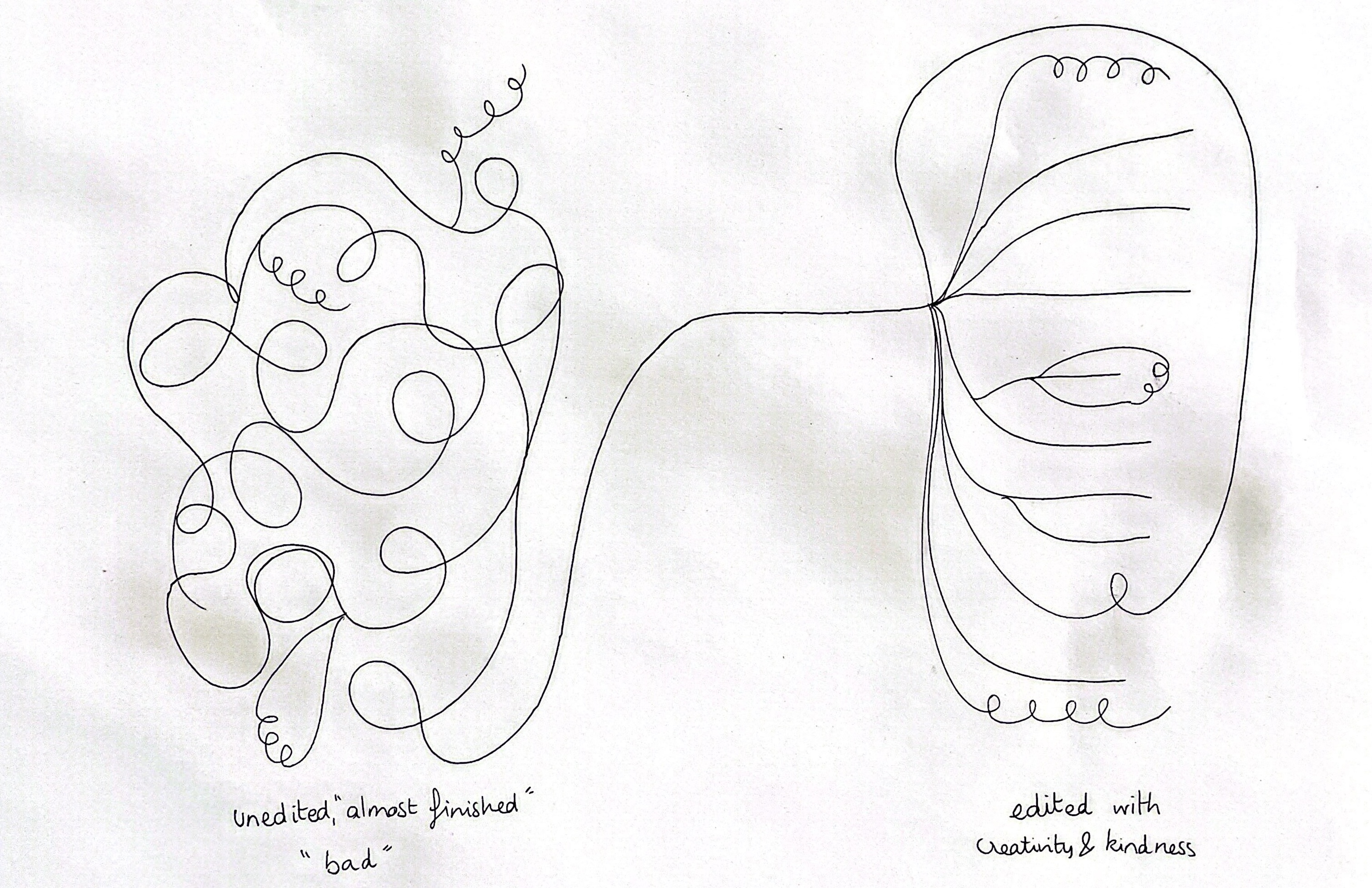
In that way, editing is a completely different task from writing. Last September, I conducted market research where I asked small business owners and freelancers whether they edited their work and how. Half of them did. When I asked, “If you had a magic wand that could improve your writing, what would it be?,” many said they’d want to improve clarity, construct ideas so everything “flows better,” use visual metaphors, make language more descriptive and less abstract, make sentences shorter and more impactful… These are all things that can happen when we dedicate time to editing. This way, we can preserve precious “flow writing” time.
Over time, editing becomes easier and influences the writing: We already have a better sense of where we want to take our ideas and how. We often get frustrated with editing because we assume it needs to “flow,” much like how we feel when we write. We also don’t know how to execute on our “magic wand” list, so it ends up feeling tedious and requiring a lot of mental labor instead of feeling like a creative and learning experience.
But editing is like becoming a detective, and it can be tricky switching hats between the hypothesis (who killed wealthy crime novelist Harlan Thrombey… ?) and looking at the tiny details (a speck of paint on a pair of shoes) to make sure the story, the opinion, the teaching (you will pay for your sense of entitlement) lands like we intend it to. (That’s the plot of Knives Out, by the way.)
Now, I am no Ollivander and cannot hand out magic wands. But I do have some ingredients that anyone can put into a potion to become a better self-editor! So, here are four things that happen when we edit and the purpose they serve.
1. High-level thinking: For better structure + building a content ecosystem that feels true to where you’re going
In the grand scheme of things, what do you really want to say at this moment in time? Does it match the overarching purpose of your publication, and how that relates to your professional goals? Why is this piece of information important to share? How will it contribute to the reader’s understanding of your opinion, and why should they care? What kind of digital context is this for — a newsletter, an essay, or a flagship piece on a website? All these questions are relevant to ask every time you sit down to edit your piece. If you have a guiding document for your publication, like an editorial line, it is the time to check your piece against it (that could be described as “front-end editing,” in the words of Mallary Tenore Tarpley.) Here, I explain what an editorial line is.
2. Presenting & organizing information: For idea “flow” + developing a recognizable and consistent voice
Feelings, thoughts, stories, hard facts… No matter what information you present, editing involves reviewing how you convey that information and whether you’re happy about its structure, format, and framing. Are you okay with this only being a story, or would your reader like some practical information they can apply within their own context? Should this be a quick blog-style piece, or would it deserve more thinking time to be turned into a cultural commentary piece? Or, how about adding a personal narrative to your teaching of the core concept you are introducing?
In an age where information overflows and overwhelms, thinking twice about your writing and how you present those ideas can make your point easier to remember and more impactful. I wrote about journalist Chanté Joseph’s original way of using sources here.
3. Getting curious about language: For ease of reading + accuracy
Understanding how language works can give us the tools to make our writing more impactful, softer, kinder, bolder, or more colorful – and simply more “you.” That sentence you just read uses the Oxford comma, which makes it easier to process sentences that contain lists. But if I were a poet, I might have written…
Come join my editing workshop (a poem)
Tools to make
your writing
more impactful
softer kinder bolder or
more colorful
and simply more
you
See?
4. Self-awareness: For better decision-making and long-term publishing consistency
What formats come easily to you? What ideas do you prefer to engage with? Editing is a time to look at how you write with more distance. Defining your writing over time can help you make decisions aligned with how you creatively think about ideas and what you want to achieve with them professionally. Unless writing is a hobby, that last bit is essential to keep in mind to justify the time investment in your writing. So, if you discover that you like to engage with ideas deeply, and that your ideal client and reader profile does too, but you cannot write 2,000-word essays every week, that will also help you set a publishing pace that makes it sustainable in the long run.
Have I convinced you to put on your creative editor hat before you publish next? I hope so!
If not, here’s your invitation to do it together: Join my editing workshop!
Did this article make you curious about becoming a better self-editor?
Do you want to hit publish and think, wow, I wrote this, I’m so proud! more often?
Do you want to give your “to edit” folder full of “good enough” writing new life?
Do you want to learn practical techniques and tools to make your writing “better?”
Then the workshop is for you. Here’s how it will go:
Sign up and submit a piece of your own writing to get a chance to get it edited by yours truly, a seasoned and former magazine editor :)
Hop in the Zoom room on February 18th for 2 hours of cozy learning with me and fellow writers.
I will walk you through my editing process, how I think, what prompts an edit, and give you practical tools you can use straight away for your writing. (~1h)
We will set a timer and dedicate some time to applying what you’ve learned to your own writing. (~30-45 minutes)
We will then share our experience, take a few minutes for feedback, and say until next time!
It will be two hours of coziness, creativity, learning, and gentle accountability.
Convinced yet?
Here’s what other participants have said about the editing workshop:
Ely’s editing is very honest, precise, and thorough, and at the same time very kind and gentle. She has the ability to explain the reasoning behind her changes clearly and to nudge you gently with her suggestions. I’m usually quite scared of feedback, but this was pure joy. – Federica Bruniera, freelance translator and travel writer
I loved seeing how Ely manages to edit on several levels at once, really showcasing the writer’s voice and style, and giving very encouraging, motivating, and substantial feedback. She showed us step by step how she polished the piece without losing any of the writer’s voice. – Laura Puttkamer, freelance journalist & strategic comms
I promise you, there will be not an ounce of judgment allowed! Just tools to help you get what you love about your ideas and your voice to shine through. I cannot wait to receive your submissions and discover your world!
I hope to see you there.
In the meantime,
Happy sailing!
Ely
And speaking of editing, this piece was edited by Jordan Reed, who edits all my essays. Yes, even editors need editors!